


Case study
Observatory Wines
Blair Gillingham took over Summerland Estate Winery and rebranded it as Observatory Wines. We built a custom website that runs on Shopify, a CMS (content management system) that Blair controls, and a shop optimized for DTC (direct-to-consumer) sales.
Winery website design
Observatory sits at 400 metres of elevation, looking out over Okanagan Lake, with one of the best views in the valley. Understandably, Blair sees weddings and events as another revenue stream for Observatory. So the website had to make it easy for people to picture their wedding or event there, while still creating a distinct brand identity and allowing someone to book a tasting or buy wine in just a couple clicks.
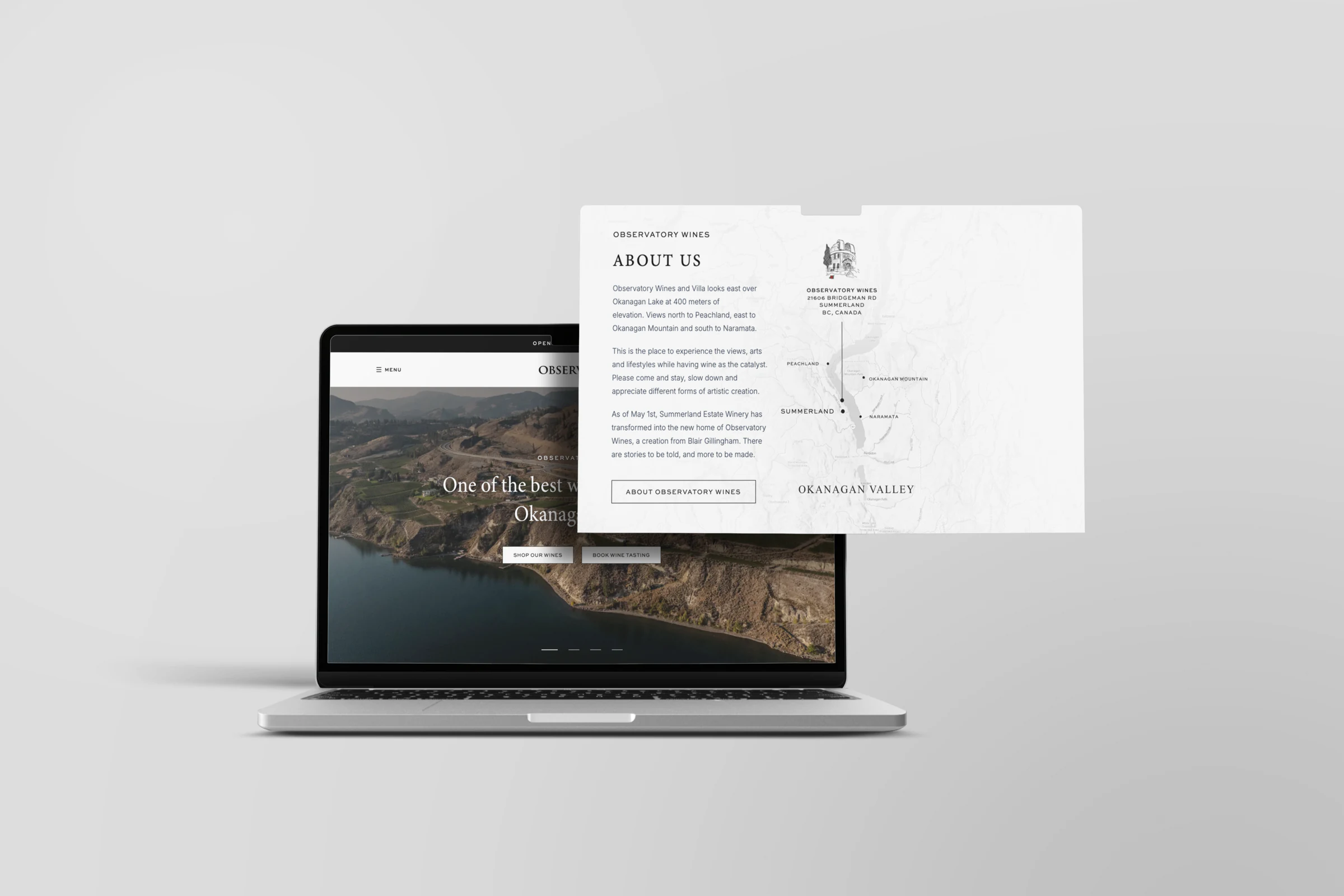
We kept the website’s layout simple, using serif type along with plenty of white space. For people to truly see themselves there, we made the photography a key focus. When you land on the website, you feel like you’re already standing on Observatory’s deck looking out at the lake.
Custom wine profiles
At one point in time, standard product templates converted for DTC sales. As consumers have become savvier, sleeker user experiences are now the baseline. It’s the difference between someone adding to cart or not. Plus, we know that Blair is busy so we set out to create a website that updates itself as much as possible instead of him having to manually update everything.
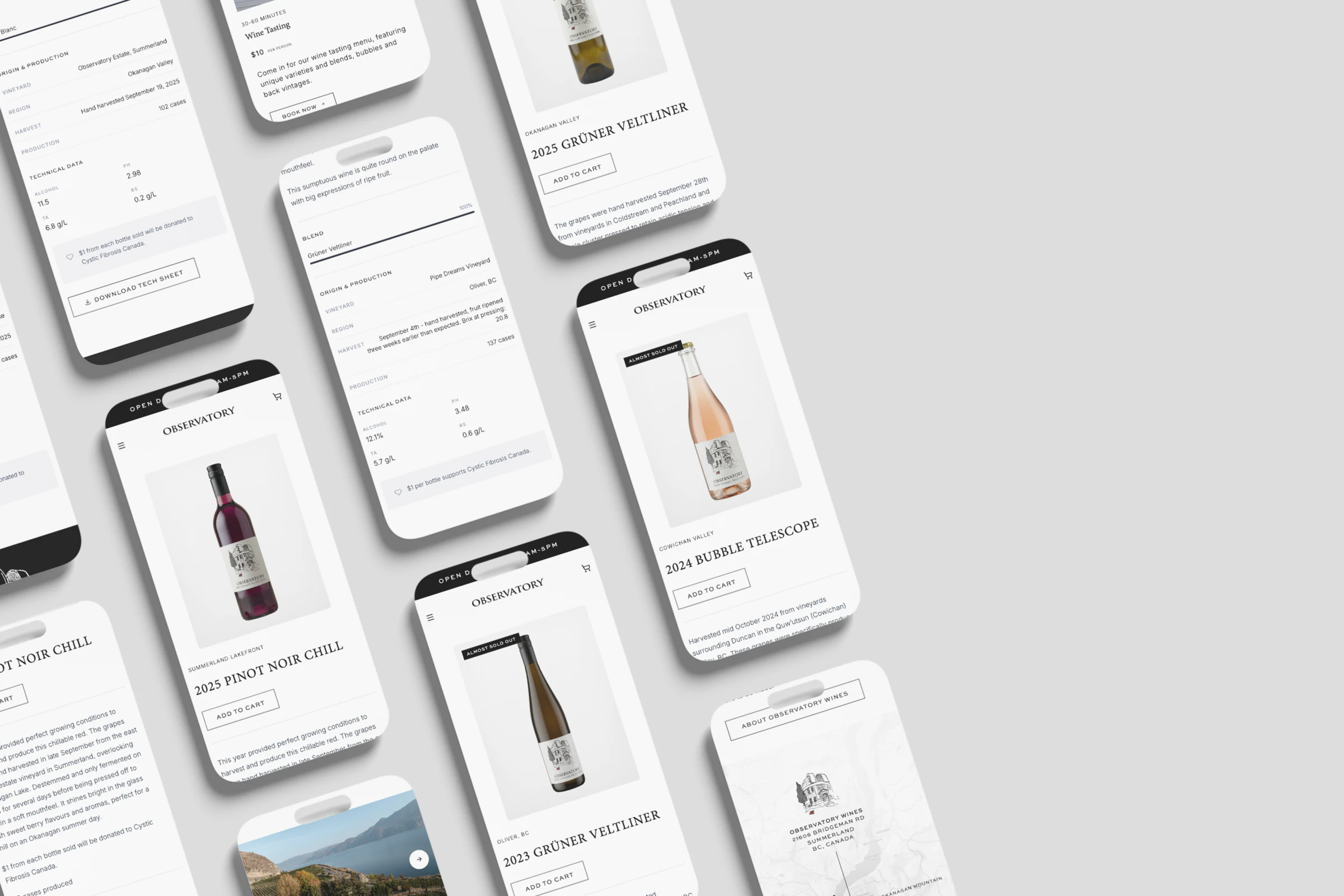
We set up the shop page so that Observatory can add a custom badge to any wine, whether that’s a point score or a wine club exclusive. On the product pages, the blend is a bar chart instead of a sentence. All of the information is there, for instance “60% Pinot Blanc, 20% Pinot Gris, 20% Pinot Noir” however it’s been made into a visual to appeal to a larger audience. Production details and technical data get the same treatment, set out in clear sections rather than long-form copy. Especially for the wine trade, this approach delivers the information simply and quickly. Wine writers love not having to scour your website for information.
Custom maps
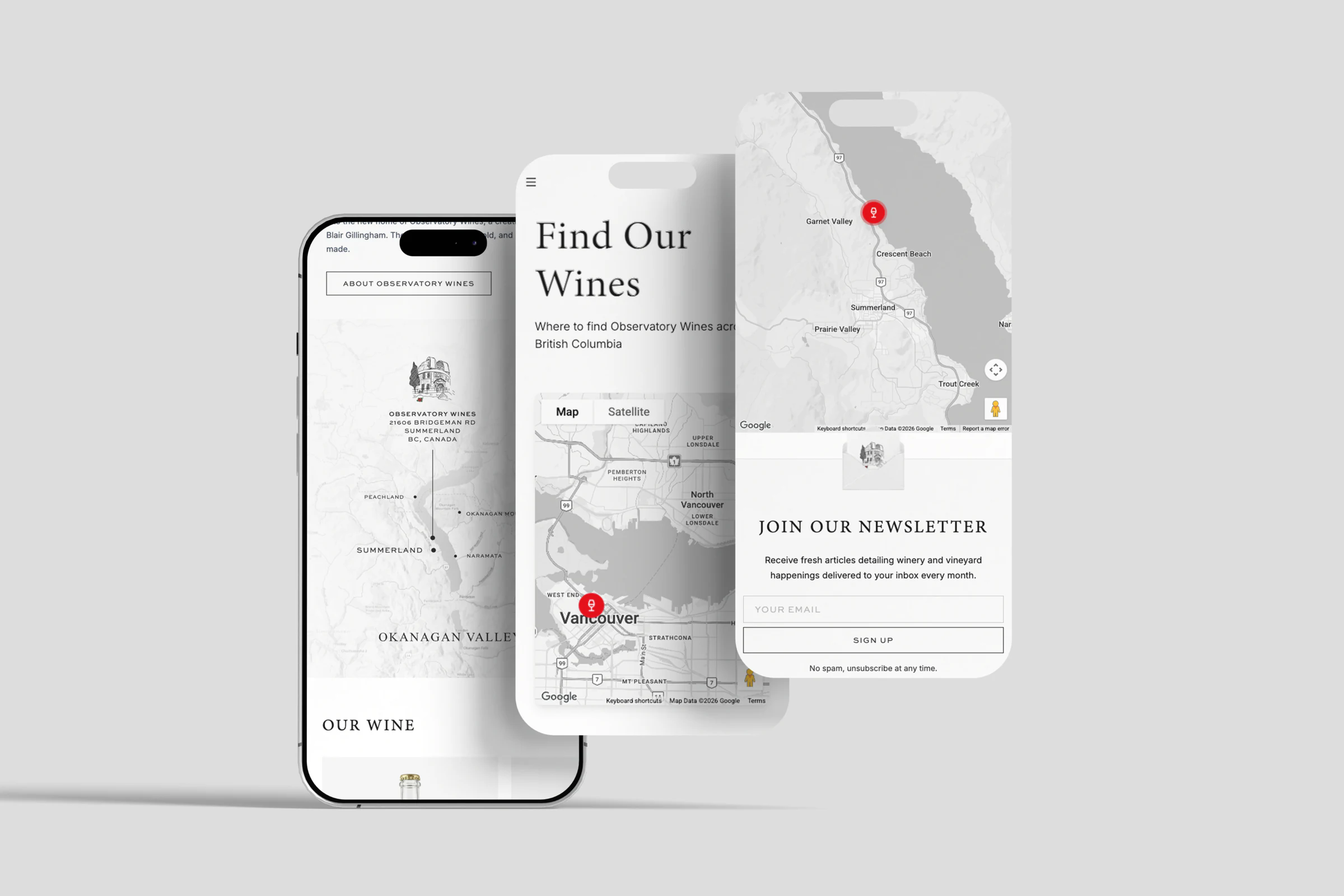
We drew custom maps to fit with the website’s clean aesthetic that used lots of white space. With a standard Google Maps embed, every other business in Summerland would have been pinned over Observatory.
The map on the home page is static and shows the estate in the valley, while the map on the Find Our Wines page is interactive, showing stockists across Canada. When you click on a pin, you’ll see which wines the stockist carries, each linked to its product page. Lastly, the map on the contact page is there for directions.
A site the winery updates itself
Having a custom website means that there’s no drag-and-drop page builder behind it. Instead, the content runs through a CMS so all of it can be changed without needing a web developer. For instance, when tasting room hours shift or an event is added, Blair can make those edits within minutes without having back-and-forth emails with a developer that he’ll get charged for.
Wine e-commerce on Shopify
The site was built around having one system to hold all the data from the shop, the tasting room POS, the wholesale orders and the event tickets. We mostly build custom e-commerce websites on Commerce7 since it’s made specifically for the wine industry. However, knowing that Blair was getting Observatory off the ground, we compared Commerce7’s entry plan against Shopify’s. Shopify came in about a quarter of the monthly price. While it didn’t have all the features that Observatory would need, like bottle deposits and tasting reservations, we could custom build those within Shopify and save Blair a lot of money. Commerce7 has a lot of extra features that at this stage Observatory won’t use, so why pay for that before you have to? We treat our clients’ projects as if we’re spending our own money.
Measuring DTC wine sales
Shopify handles the sales reporting: orders, average order value, returning customer rate, sales by wine, and tasting room sales versus online sales.
Because the POS and the online shop share one customer record, someone who buys online in March and books a tasting in July shows up as one customer, not two.
Google Analytics and Search Console measure how people got to the website (and what they searched to get there), what they looked at, and where they left. The site is also set up for Meta tracking. Sales campaigns can be measured accurately and audiences for Meta ads can be built from actual buyers. And because the tasting room POS is on the same Shopify account, in-person sales can be sent back to Meta as offline conversions, so an ad can get credit for a purchase made at the counter.

